Monoculture: How One Story is Changing Everything by Michaels F.S
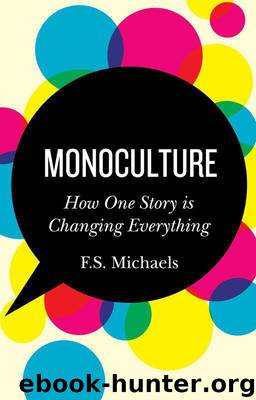
Author:Michaels, F.S. [Michaels, F.S.]
Language: eng
Format: mobi, epub
Tags: Business and Economics, Social Science - General
Publisher: Red Clover Press
Published: 2011-04-25T04:00:00+00:00
Government is the only body in society that’s legally allowed to use force and coercion against you in order to keep the social order. If you break the law, it’s the government that can take away your freedom and sometimes even your life as part of its exercise of authority. In America, when you’re convicted of a crime, the government takes away your freedom by sending you to prison.
Prisons have existed for thousands of years — once used only sporadically though because of the expense — but governments haven’t always been involved in punishing crime. In the Middle Ages in England, crime was thought to concern only the criminal and the victim, not the criminal and the rest of society, so government, representing society’s interests, didn’t have a role to play. Blood feuds developed as a result, but even so, the tradition of non-government intervention lasted until the 1800s.11
It wasn’t until the Enlightenment that crime became thought of as something that affected all of society and not just the victim. Crime became a public issue, an offence against the state that now had to be handled by the state’s officials.12 Governments protected the public and the public interest by sending criminals to prison as retribution (because they deserved it), deterrence (so they wouldn’t do it again), incapacitation (so they couldn’t do it again), or reform and rehabilitation (changing behavior and attitudes).13
All of that government activity cost money, and during the 1800s, the government started contracting out prisoners as workers across America, sometimes into appalling conditions; slave labor was disappearing after abolition, and prison labor was seen as a substitute for it. The practice of contracting out prisoners as workers was widespread. In 1825, the state of Kentucky, in financial crisis, leased its prisoners to a businessman for $1,000 a year for five years. New York’s Sing Sing had its prisoners work in marble quarries. Other prisons had their occupants make shoes, clothes, carpets, or furniture to help defray the public cost of crime.14 Contracting prisoners out served two purposes: prisons started making the government money instead of costing it, and work, said the Protestant work ethic, could itself be used to reform a prisoner’s character.
Not everyone was happy with the arrangement. Unions and manufacturers complained that prison labor undercut the work of free men and entrepreneurs. Too, prison conditions ended up being so bad and inmate exploitation so widespread that public agencies were eventually forced to assume responsibility for prisons.15 Leasing convicts out as workers ended in 1923, and contracting prisoners out to private firms had mostly disappeared by 1940. Prison became an expensive proposition for government again.16
Download
Monoculture: How One Story is Changing Everything by Michaels F.S.epub
This site does not store any files on its server. We only index and link to content provided by other sites. Please contact the content providers to delete copyright contents if any and email us, we'll remove relevant links or contents immediately.
Rewire Your Anxious Brain by Catherine M. Pittman(18658)
Talking to Strangers by Malcolm Gladwell(13376)
The Art of Thinking Clearly by Rolf Dobelli(10495)
Mindhunter: Inside the FBI's Elite Serial Crime Unit by John E. Douglas & Mark Olshaker(9350)
Becoming Supernatural by Dr. Joe Dispenza(8225)
Change Your Questions, Change Your Life by Marilee Adams(7788)
Nudge - Improving Decisions about Health, Wealth, and Happiness by Thaler Sunstein(7712)
The Road Less Traveled by M. Scott Peck(7606)
The Lost Art of Listening by Michael P. Nichols(7509)
Mastermind: How to Think Like Sherlock Holmes by Maria Konnikova(7353)
Enlightenment Now: The Case for Reason, Science, Humanism, and Progress by Steven Pinker(7316)
Win Bigly by Scott Adams(7204)
The Way of Zen by Alan W. Watts(6621)
Daring Greatly by Brene Brown(6520)
Big Magic: Creative Living Beyond Fear by Elizabeth Gilbert(5780)
Grit by Angela Duckworth(5623)
Ego Is the Enemy by Ryan Holiday(5455)
Men In Love by Nancy Friday(5250)
The Laws of Human Nature by Robert Greene(5214)
